A Beginner’s Guide to Choosing and Playing the Ukulele
Discover the Joy of Music with This Charming Instrument
Compiled and written by Jim Holcepl
Introduction
The ukulele, with its bright and cheerful sound, has captured the hearts of music lovers worldwide. Whether you’re a complete novice or an experienced musician looking to try something new, the ukulele is an excellent choice. This guide will walk you through the process of choosing the right ukulele and provide you with the essential steps to start playing this delightful instrument.
Choosing Your Ukulele
Types of Ukuleles
Ukuleles come in four main sizes: soprano, concert, tenor, and baritone. Each size has its unique characteristics, and the choice depends on your preferences and playing style.
- Soprano: The smallest and most traditional size, known for its bright and jangly tone. It’s perfect for beginners and those with smaller hands.
- Concert: Slightly larger than the soprano, offering a fuller sound while still being comfortable for most players. It’s a popular choice for both beginners and intermediate players.
- Tenor: Larger than the concert, with a deeper and richer tone. It’s preferred by those who want a more robust sound and larger fret spacing.
- Baritone: The largest ukulele tuned differently (similar to the bottom four strings of a guitar). It’s ideal for guitar players transitioning to the ukulele or those who prefer a mellower tone.
- U–Bass: This is a ukulele shaped bass that is played like a bass guitar. Usually, it has built in electronics and uses an amplifier to produce the sound required.
Materials and Build Quality
Ukuleles are made from various materials, each affecting the instrument’s sound and durability.
- Laminate Wood: Affordable and durable, but may lack the richness of solid wood ukuleles.
- Solid Wood: Produces a warmer and more resonant tone but is generally more expensive and requires better care.
- Plastic: Lightweight and durable, perfect for travel and young players, though it may not offer the best sound quality.
Budget Considerations
Your budget will play a significant role in choosing a ukulele. While it’s tempting to go for the cheapest option, investing a bit more in a quality instrument can make a big difference in your playing experience. There are numerous ukulele brands that offer a nice instrument at a reasonable price, such as KALA, FLIGHT, AMAHI, LANIKAI, LUNA, ALVAREZ, CORDOBA, DONNER, FENDER, MARTIN, OHANA, KAMAKA, MITCHELL and many others. Prices can vary based on size of Ukulele, material used and reputation of the builder. This can be from $30 to over $3000+.
Trying Before Buying
If possible, visit a music store to try different ukuleles. Pay attention to how each one feels in your hands, the sound it produces, and the overall build quality. Don’t hesitate to ask for advice from store staff or experienced players. Or asked those of us in the ukulele group their opinion on size and suggestions on where to buy. (online or in a music store) North Olmsted Ukulele Society has two ukuleles which you can try which was generously donated by KALA ukulele company.
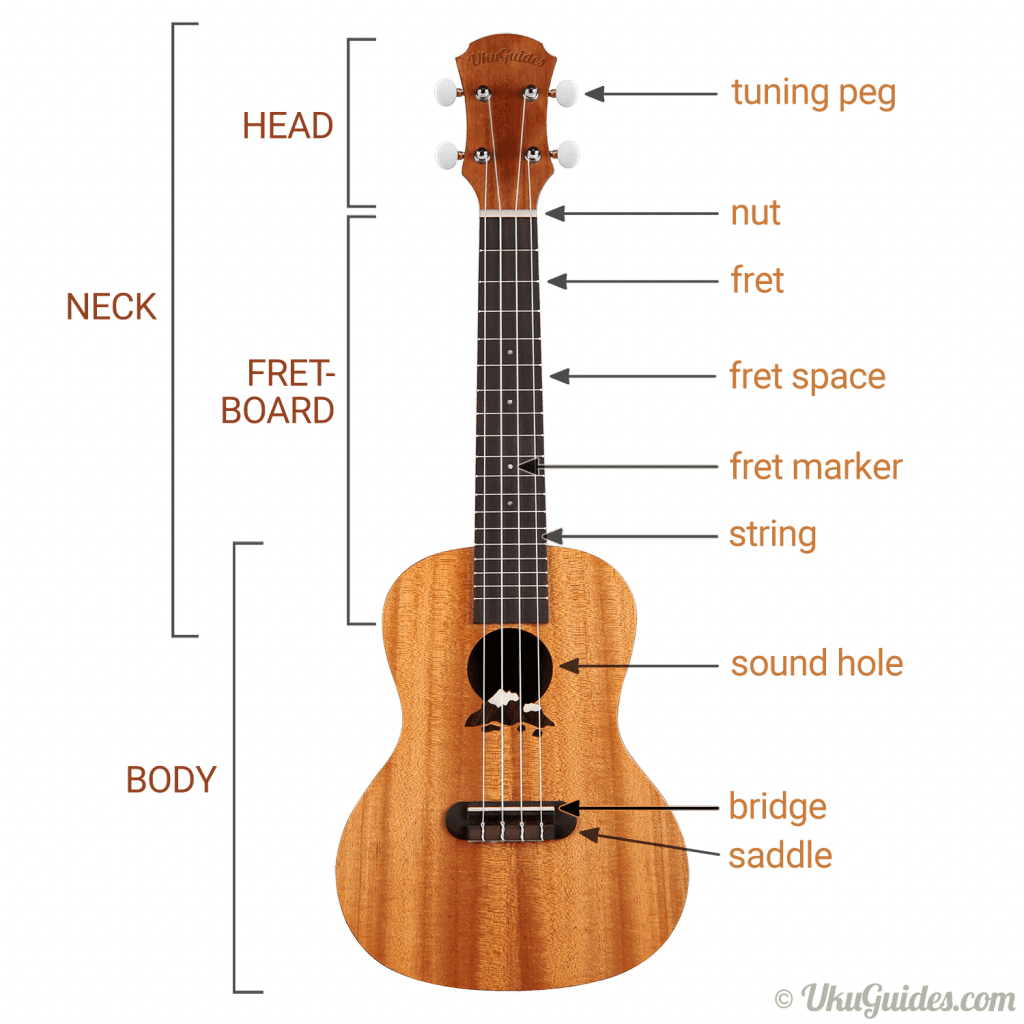
Parts of a ukulele:
Getting Started with Playing
The Correct Way to Hold a Ukulele – Tips and Ideas

A comfortable playing position
What is the Right Way to Hold your Ukulele?
The right way to hold a ukulele is the way that gets the best sound from your uke. This simply means finding the most comfortable and correct position for you.
Start by cradling the uke close to your chest with your strumming arm and hold it in place with your fretting hand which will form the chord shapes and individual notes. If sitting down, you have the option of balancing it on your knee.

You can hold your uke in the crook of your arm
Playing Standing Up
When standing up to play you can use a strap for support, but as the ukulele is so small it is quite possible to go strapless. You can hold it in the crook of your strumming arm with your other hand free to move up and down and support the fret board.
Some players like the use of a strap that allows them to secure the ukulele better to play.
Tuning Your Ukulele
Proper tuning is essential for a pleasant playing experience. The standard tuning for soprano, concert, and tenor ukuleles is G-C-E-A. Some players prefer that the G string be what is called “low G”. This is a string that is made to play the G note lower that what would be heard on a standard tuning “high G” instrument. For baritone ukuleles, the tuning is D-G-B-E. Use a tuner or a tuning app to ensure your ukulele is in tune before playing. We recommend purchasing a clip-on tuner. Some ukuleles which have built in electronic pickups will have a tuner included.
Basic Chords
Learning chords is how you become a better player. This allows you to play along on thousands of songs. Start by learning a few basic chords will allow you to play a wide variety of songs. Check out on line resources for chord shapes.
- Playing in our ukulele groups will help you expand your knowledge of chords and the fun of being able to strum along to many songs.
Strumming Patterns
Strumming is what gives rhythm to your playing. Start with a simple down-up strumming pattern and gradually experiment with more complex patterns as you become comfortable.
Practice Regularly
Consistency is key to improving your skills. Set aside a specific time each day to practice. Even 15-20 minutes a day can make a significant difference over time.
Learning Resources
Online Tutorials and Courses
There are numerous online resources available for ukulele learners. Websites like YouTube have countless tutorials for beginners, many of the popular ukulele artists have websites on YouTube that offer lessons.
Songbooks and Sheet Music
Invest in a good ukulele songbook or download sheet music for your favorite songs. This will help you practice playing along with actual music and improve your chord transitions. We recommend the Liz and Jim Beloff “The Daily Ukulele” books which are full of songs and Ukulele 101 on playing along with helpful chord charts. Several other excellent sources include the Dr Uke website https://www.doctoruke.com/songs.html and the Austin Ukulele Society website https://austinukulelesociety.com/about/ Also on a local level check out NEOUKE https://www.facebook.com/groups/1027665310633319
Many players visit these sites to learn new songs and often can play along with the videos or the audio.
Community and Support
Joining a ukulele community, whether online or in person, can provide valuable support and motivation. Participate in forums, attend local ukulele clubs, or join social media groups to connect with other players. We recommend locally the strums in Amherst, Avon Lake, North Olmsted, Middleburg Hts. There are also clubs in the Akron area and Cleveland Hts.
Maintenance and Care
Storing Your Ukulele
Store your ukulele in a cool, dry place away from direct sunlight and extreme temperatures. A padded gig bag or hard case will protect it from damage.
Cleaning and Upkeep
Regularly wipe down the strings and body of your ukulele with a soft cloth to remove dirt and oils. Check for any loose parts and tighten them as needed. Change the strings periodically to maintain the best sound quality.
Conclusion
Choosing and playing the ukulele can be a rewarding and enjoyable experience. With the right instrument and a bit of dedication, you’ll find yourself strumming along to your favorite songs in no time. Remember to have fun and embrace the journey of learning this charming instrument. You will find that the ukulele community is an open and welcoming place that has friendly people willing to help each other enjoy making music together. Happy strumming!
Music tablature or tab is essentially another kind of musical notation for stringed instruments (as distinct from staffs, with treble clefs and notes). It is a lot simpler than musical scores for the piano, let’s say, so it shouldn’t be that difficult to learn. Tabs can be very handy to have when you are trying to learn a fingerpicking song. They show you exactly where to place your fingers on the fretboard and usually show the tempo as well. Note: if you know how to read guitar tabs, you also know how to read ukulele tabs!
Basics of how to read ukulele tabs – you gotta start somewhere
Let’s start at the very beginning, with the base of a tablature and how to read ukulele tabs. The very basis of every single tab is these four lines, usually shown with dashes. Each line represents a string, from bottom to top: GCEA. So when you are looking at the neck of your ukulele (with the headstock at the top and the body at the bottom) the G string is the one furthest to the left and A is the one furthest to the right.
xA|—————————–|
xE|—————————–|
xC|—————————–|
xG|—————————–|
Starting with this base, numbers will be written over the “strings” and it will look something like the illustration below. But how do you play this? A tab is always read from left to right and each number refers to the fret number. In this example you would: pluck the 3rd fret of the bottom string (A). Then you would pluck the open E string (open string = 0), followed by the open C string. Then the open G string. Then… you see, you already know how to read ukulele tabs!
xA|—-3————————|
xE|——–0—————0—-|
xC|————0——-0——–|
xG|—————-0————|
Chords in tablature
Most of the time you will simply see the chord name above the lyrics or a few chord names next to each other. However, it may be that chords are shown as below. This means that you should play all the notes vertically aligned together (as a chord). Here you can see the following chords: F, G, C, Am, D7 and G7. This is mostly used when people are trying to show you what the rhythm and tempo is.
xA|—-0—2—3—0—3—2—-|
xE|—-1—3—0—0—2—1—-|
xC|—-0—2—0—0—2—2—-|
xG|—-2—0—0—2—2—0—-|
 NORTH OLMSTED UKULELE SOCIETY Building a community one chord at a time!